


trusted by 400+ businesses
4.9/5 stars

The EMPHN catchment
The future we are building is guided by three strategic pillars that will shape how EMPHN responds to the evolving needs of our communities and health system.
Equity
Drive equitable access and outcomes for communities
Data
Leverage insights to improve outcomes, drive value and demonstrate impact
Integration
Connect our partners and communities to enable integration and change
Together, these priorities focus on improving equity, strengthening the use of data and insights, and enabling greater integration across care. Explore the pages below to learn more about the future we are working towards, the progress made during 2025–26, and the initiatives helping to drive lasting change.
Population snapshot
Health data
EMPHN's catchment
Younger people
(under 25)
People aged
25–65
Older adults
65+
Source: Public Health Information Development Unit (PHIDU), 2023
First Nations
Source: PHIDU, 2023
LGBTQIA+
Source: VAHI, 2021
Language spoken at home*
Chinese+
Indo Aryan++
Greek
+ Chinese is combined of Mandarin, Cantonese, Other.
+ + Indo Aryan is combined of languages: Indo-Aryan languages include: Bengali, Gujarat, Hindi, Nepali, Punjabi, Sinhalese, Urdu, Other.
Source: ABS 2021
of people speak a language other than English at home
Source: ABS, 2021
born in a non‑english speaking country
Source: PHIDU, 2023
Unemployment rate
Source: Jobs and Skills Australia, 2023
Low individual income (<$41.6K)
Source: ABS, 2021
Low household income (<$65K)
Source: ABS, 2021
Experiencing homelessness
Source: PHIDU, 2023
A snapshot of the community
Health data
estimated people living with one health condition*
estimated people living with two chronic health conditions*
Diabetes risk
An estimated 10,884 undiagnosed EMPHN residents are at risk of developing type 2 diabetes within the next 5 years.
Based on AUSDRISK risk estimates, individuals in the high-risk group have a 15.15% five-year risk of developing type 2 diabetes, compared with 9.18% for those in the intermediate-risk group.
First Nations residents
5,356 First Nations residents are living with at least one chronic condition.
The most prevalent disease categories are respiratory (60%), cardiovascular (38%) and musculoskeletal (27%).
Mental and behavioural health comorbidity is present in 49% of this population.
People living with multiple chronic conditions
382,118 people are living with two or more chronic conditions.
80% of people with multiple chronic conditions have cardiovascular disease.
Musculoskeletal conditions affect 63%, while respiratory conditions affect 43%.
People living with chronic disease and a mental health condition
261,152 people are living with both a chronic condition and a mental health condition.
The most common chronic conditions are cardiovascular (50%), respiratory (50%) and musculoskeletal (41%).
Anxiety and stress-related disorders (67%) and mood disorders (47%) are the most prevalent mental health conditions.
Culturally diverse residents
396,262 culturally diverse residents are living with at least one chronic condition.
The most prevalent disease categories are cardiovascular (53%), musculoskeletal (39%) and respiratory (39%).
Mental and behavioural health comorbidity is present in 27% of this population.
EMPHN's catchment
The east and north-east of Melbourne catchment spans nearly 4,000 square kilometers, encompassing a mix of urban, suburban, and semi-rural communities across a diverse region of Victoria.
Our community is also growing. By 2030, EMPHN’s population is projected to increase by 22% to approximately 1.9 million people, one of the largest growth corridors in the country. The region is marked by a blend of densely populated urban areas, growing suburban developments, and expansive natural landscapes, offering a wide range of community needs and healthcare challenges.
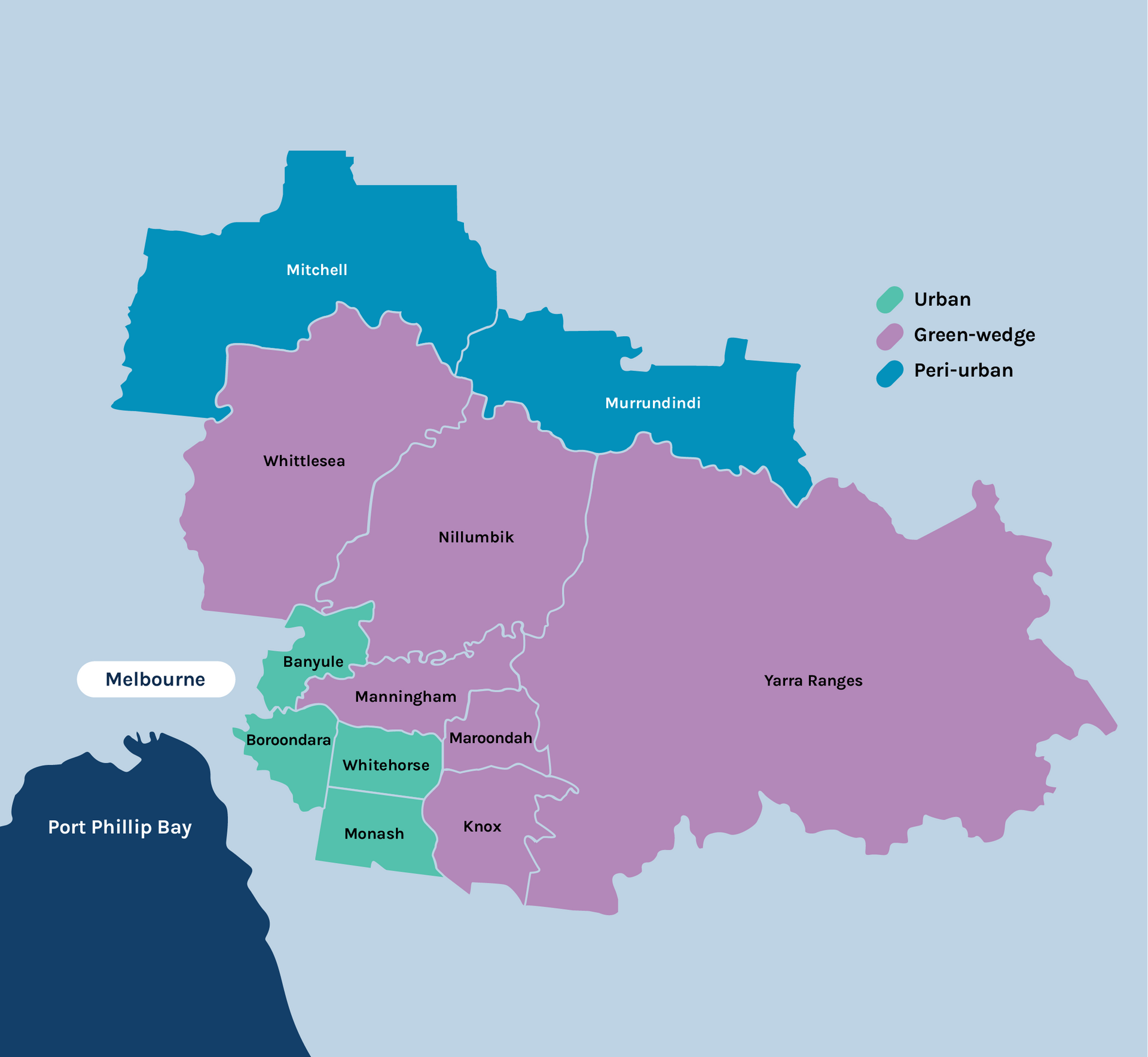
Our reach
We work across all or part of the 12 local government areas (LGAs) below.
These LGAs are entirely within EMPHN’s catchment:
- City of Whittlesea
- Shire of Nillumbik
- City of Banyule
- City of Manningham
- City of Maroondah
- City of Boroondara
- City of Whitehorse
- City of Knox
- City of Monash
EMPHN’s catchment also covers part of:
- Shire of Mitchell (35% of population)
- Shire of Murrindindi (27% of population)
- Shire of Yarra Ranges (portion which falls outside the EMPHN catchment is largely uninhabited national park)